Key Takeaways:
- The best flooring software depends on your business size, workflows, and growth goals.
- Look beyond features. Ease of use, support, and scalability matter just as much.
- QFloors: Comprehensive ERP, accounting, inventory, and business management.
- Cyncly (RFMS/Broadlume): Enterprise-level solution for larger flooring retailers.
- Floorzap: CRM, lead management, and customer communication tools.
- Flooring OS: Modern cloud-based platform with streamlined workflows.
- ServiceBuddy.io: Scheduling, job management, and field service coordination.
If you’re a busy flooring dealer bogged down by paperwork, redundant data entry, system inefficiencies, or frequent inventory discrepancies, your software may be creating more work than it’s saving.
What your business software should be doing is connecting sales, inventory, purchasing, scheduling, accounting, and customer information in one place. It should actually enable your team to work more efficiently, and give you better visibility into your business.
But choosing flooring software isn’t about finding the platform with the longest feature list. It’s about finding the system that best supports the way your business operates. Whether your priority is inventory control, estimating, customer communication, financial reporting, or overall profitability, the best solution should strengthen those areas without creating new gaps elsewhere.
In this comparison guide, we’ll break down this year’s leading flooring software systems to help you find the right fit.
What to Ask When Researching & Comparing Flooring ERP Software
Choosing flooring business software goes beyond features. The real question is whether it fits how your business sells, schedules, and operates. As you evaluate platforms, consider these questions:
1. What are my top 5 priorities? What does the software need to do?
Every flooring dealer operates a little differently, so instead of trying to evaluate everything at once, a better approach is to start by identifying your top priorities.
Before you start comparing flooring ERP software platforms, it helps to think of your top 5–10 priorities and rank them in order of importance. For example one dealer might say that for them the most important things are:
- Keeping inventory accurate and accessible
- Maintaining accurate financials
- Reducing time spent creating estimates and processing orders
- Keeping installation schedules organized and on track
- Having a system that can be used by everyone in the organization
Once you know what matters most, it’s easier to evaluate your options. You stop chasing the “perfect” system and start focusing on what actually fits your business.
2. Will this business software support the type of flooring work I do?
Not all flooring software is built for the same type of dealer. What works for small contractors may not support larger commercial jobs, multiple locations, or complex inventory and accounting.
Before comparing features, make sure the software is designed for the way your business operates.
3. Do I want an all-in-one system, or separate tools?
Some flooring ERP software programs manage your entire business in one system (sales, inventory, accounting, and operations, etc.) Others require you to rely on tools like QuickBooks or spreadsheets to complete key parts of the workflow.
If accurate job costing, inventory tracking, and financial reporting are important, this choice has a big impact.
4. Is this a short-term solution or a long-term system that can grow with my business?
Your needs today may not be the same in two or five years. If you’re planning to add locations, increase installation volume, or grow your sales team, scalability should be a key part of your decision.
5. Will my team actually be able to use this software day-to-day?
Even the most powerful system won’t help if your team struggles to adopt it. Look at how easy it is to learn, how intuitive the workflows are, and what kind of training and support is available.
QFloors
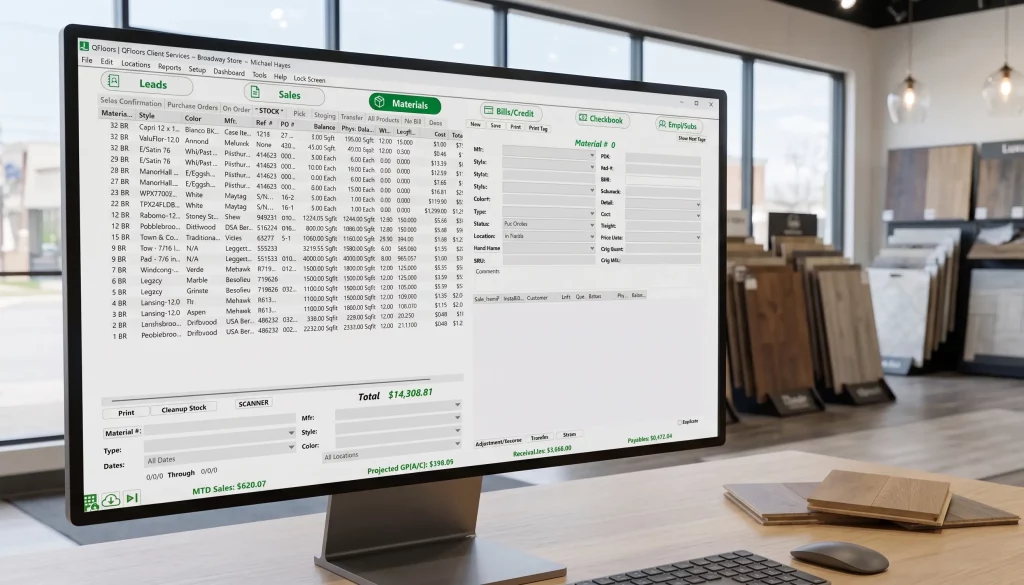
Overview
For over 25 years, QFloors has been one of the most established flooring-specific software platforms in the industry. Founded by third-generation flooring dealers, it was built specifically for the floor covering industry and includes tools for invoicing, job costing, inventory management, reporting, and financial oversight in a single system.
QFloors is designed to support flooring dealers at every stage, from small showrooms to large, multi-location operations.
In 2025, Roomvo acquired QFloors, combining Roomvo’s visualization, website, CRM, and digital showroom technology with QFloors’ established ERP platform. This partnership supports ongoing modernization efforts, including expanded mobile capabilities and tighter connections between sales, marketing, and operations.
Key Strengths
- ✅ Flooring-specific business management software
- ✅ Strong inventory and job costing tools
- ✅ Built-in accounting capabilities
- ✅ Real-time and precise financial, product profitability, & business reports
- ✅ User-friendly interface with only six main screens
- ✅ Multi-user and multi-location support
- ✅ Credit card processing, showroom tagging, and e-signature add-ons available
- ✅ Quick loading times
- ✅ Highly-regarded customer support
- ✅ Fast-moving product development and roadmap
Potential Tradeoffs
- ⚖️ Best experience is on desktop; mobile functionality is still evolving
- ⚖️ More robust than what smaller, simpler shops may need
- ⚖️ Focused on functionality over a modern, lightweight interface
- ⚖️ Does take time to implement the system
Ideal Fit
QFloors tends to fit best for:
- Flooring businesses of all sizes focused on growth and scalability
- Dealers who need accurate financial reporting and accounting visibility
- Stores that require strong inventory and purchasing control
- Companies looking for a full flooring business management system
- Teams that value depth and functionality over modern UI simplicity
Floorzap
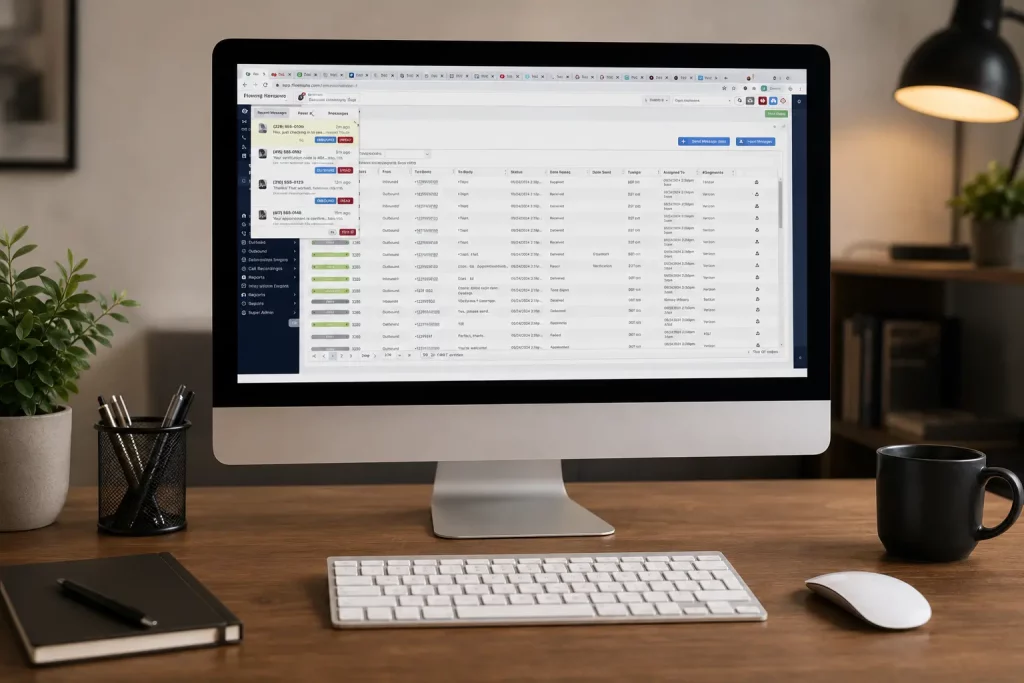
Overview
Founded in 2018, Floorzap is a modern flooring business management platform built primarily for smaller retailers. It focuses on lead generation, workflow efficiency, and customer communication through its built-in CRM tools.
It’s a strong fit for sales-driven teams, but dealers with more advanced accounting or inventory needs may need additional integrations.
Key Strengths
- ✅ Modern CRM and lead management
- ✅ Automated follow-ups and marketing workflows
- ✅ Digital estimates and approval tools
- ✅ Consumer financing integration
- ✅ Installer mobile app access
- ✅ Website and marketing integrations
Potential Tradeoffs
- ⚖️ Less emphasis on back-office accounting and operations
- ⚖️ May be better suited for smaller or less complex flooring businesses
- ⚖️ Typically requires integration with separate accounting software
- ⚖️ Some dealers may experience performance limitations and slower customer response times
- ⚖️ May require multiple systems to manage all areas of the business
- ⚖️ Updates and product development may move more slowly compared to some newer platforms
Ideal Fit
Floorzap is often a strong fit for:
- Small retail-focused flooring stores prioritizing sales and customer acquisition
- Businesses that rely heavily on CRM, lead tracking, and follow-up automation
- Flooring companies that want modern customer communication tools and workflows
- Dealers looking for a more modern, user-friendly interface
- Teams that already use separate accounting or back-office systems
Cyncly (Broadlume + RFMS)
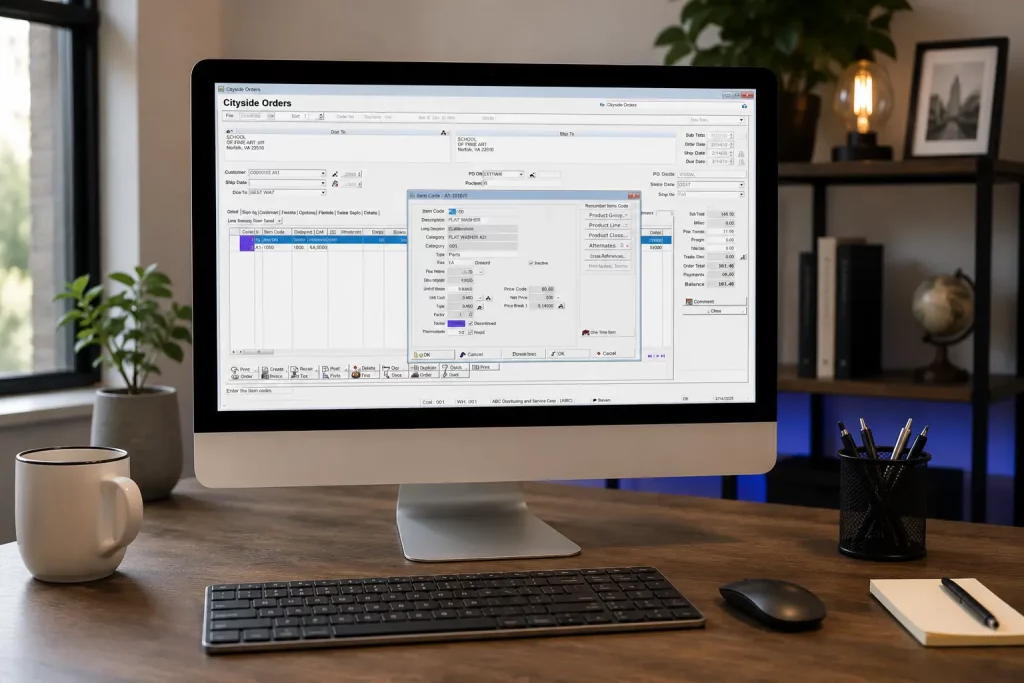
Overview
Cyncly is a software company serving the home improvement and interior finishes industry. It has grown through the acquisition of several established flooring platforms, including RFMS and Broadlume.
RFMS supports back-office operations such as accounting, inventory, order management, and reporting. Broadlume focuses on the front end of the business, including websites, marketing, lead generation, and room visualization. Together, they cover both operational and customer-facing workflows.
Key Strengths
- ✅ Comprehensive flooring ERP for day-to-day management
- ✅ Strong features for complex, multi-location businesses
- ✅ Built-in accounting, inventory, and financial management tools
- ✅ Tools designed for builder, commercial, and multi-family workflows
- ✅ Digital marketing services & features available
- ✅ Offers estimating and warehouse management phone apps
Potential Tradeoffs
- ⚖️ More complex systems take a longer time to fully adopt
- ⚖️ Longer implementation and onboarding compared to lighter platforms
- ⚖️ Daily workflows can feel more complex, with multiple steps and screens
- ⚖️ Higher cost that may increase as teams scale
- ⚖️ Requires more internal planning and system management due to platform depth
- ⚖️ Support experience may vary depending on user needs
Ideal Fit
Cyncly/RFMS is often best suited for:
- Large, high-volume flooring dealers
- Multi-location operations needing centralized control
- Businesses requiring advanced reporting and operational oversight
- Teams with structured processes and dedicated system management
- Dealers managing complex inventory and order workflows
- Businesses with the budget for a higher software investment
Flooring OS
Overview
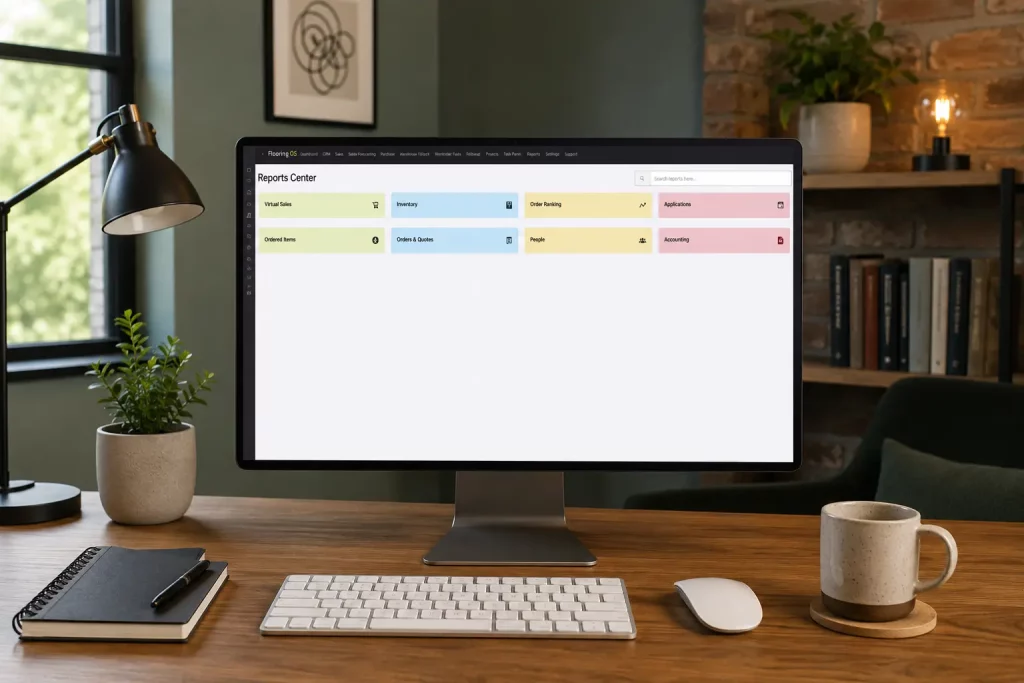
Flooring OS is a newer generation of flooring software designed to modernize the experience for retailers and contractors. It focuses on streamlining leads, estimating, scheduling, project management, and day-to-day operations in a cloud-based system.
When compared to legacy ERP platforms, Flooring OS offers a modern, cloud-first approach built for ease of use and faster workflows.
Key Strengths
- ✅ Modern, user-friendly interface focused on simplicity
- ✅ Cloud-based platform with flexible remote access
- ✅ Strong mobile usability for field and showroom teams
- ✅ Fewer features = faster onboarding
- ✅ Streamlined workflows that reduce manual steps
Potential Tradeoffs
- ⚖️ More limited accounting and financial functionality than other ERP systems
- ⚖️ Advanced job costing may require additional setup or integrations
- ⚖️ Inventory tools may be better suited for simpler operations
- ⚖️ Multi-location visibility and control may be limited
- ⚖️ Some features rely on third-party integrations
Ideal Fit
Flooring OS may fit best for:
- Small to midsize flooring retailers
- Businesses moving off spreadsheets or manual processes
- Teams that prioritize ease of use and speed over advanced ERP functionality
- Retailers looking for a modern, cloud-based system
ServiceBuddy.io
Overview
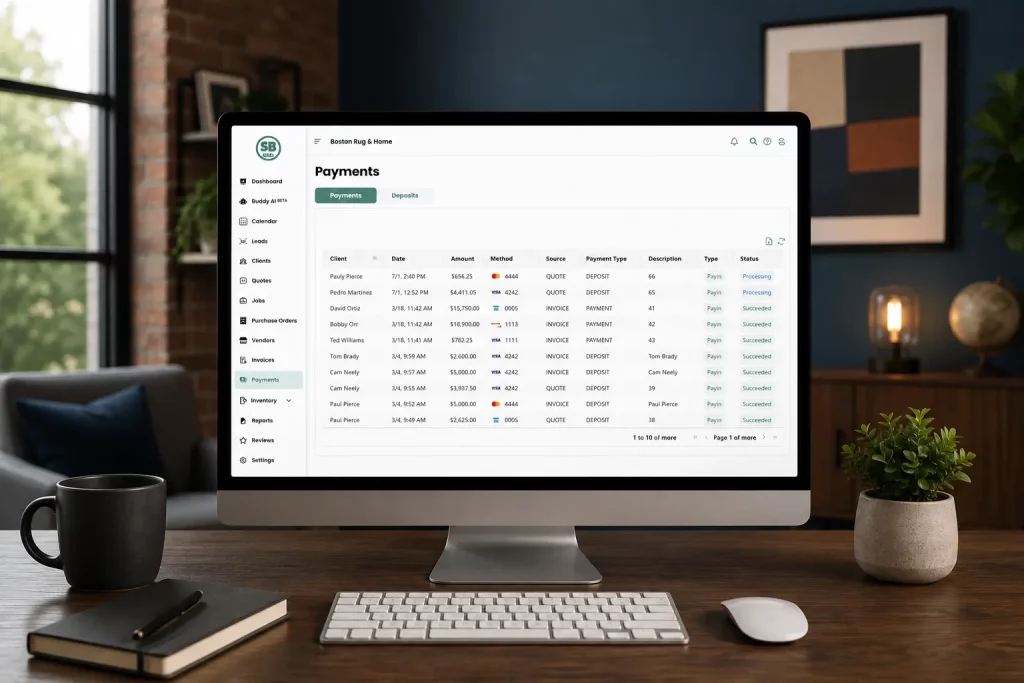
ServiceBuddy is a cloud-based platform built for service businesses to manage scheduling, job tracking, and field operations. It’s used across multiple home service industries, but can also support flooring businesses that need stronger coordination between office teams, installers, and customers.
The platform emphasizes communication and workflow visibility through mobile access and centralized job management.
Key Strengths
- ✅ Cloud-based platform with desktop and mobile access
- ✅ Strong scheduling and dispatch tools for installers and field teams
- ✅ Built-in estimating and invoicing for job quoting and billing
- ✅ Customer communication tools to improve coordination and updates
- ✅ Technician and installer management for field operations
- ✅ Simple, easy-to-use interface designed for day-to-day workflow
Potential Tradeoffs
- ⚖️ Limited advanced flooring inventory features (rolls, remnants, dye lots)
- ⚖️ No built-in accounting or full financial management system
- ⚖️ More limited reporting and analytics compared to ERP platforms
- ⚖️ May require integrations for full back-office functionality
Ideal Fit
ServiceBuddy.io may be a good fit for:
- Small to mid-sized flooring businesses focused on service and installations
- Flooring installers and field service teams managing daily scheduling and job tracking
- Companies that rely heavily on dispatching, scheduling, and on-site work
- Teams looking for a simple, cloud-based system for day-to-day operations
- Businesses that need better visibility and coordination between office staff and field crews
2026 Flooring Software Comparison Chart
Use this side-by-side comparison chart to evaluate today’s leading flooring software platforms.
| Feature | QFloors | RFMS / Cyncly | Floorzap | Flooring OS | Service Buddy |
|---|---|---|---|---|---|
| Pricing | $$$ | $$$$ | $$$ | $$ | $$ |
| Financial Statements (P&L, Balance Sheet, Cash Flow) | ✅ Full | ✅ Full | ✅ Available | ~ Unclear | ~ Via QuickBooks |
| Multi-Location Accounting | ✅ Yes | ✅ Yes | ✅ Yes | ~ Unclear | ~ Limited |
| Accounting Platform | ✅ Native Flooring Accounting | ✅ Native Flooring Accounting | ✅ Integrated Accounting + QuickBooks Sync | ~ Partial Accounting | ❌ QuickBooks-Based |
| Accounting Track Record | ✅ 25+ Years | ✅ Decades-Proven | ~ Recently Introduced | ~ Limited History | ❌ Relies on QuickBooks |
| Years Serving Flooring Industry | ✅ 25+ Years | ✅ 40+ Years | ~ Newer Platform | ~ Newer Platform | ~ Newer Platform |
| Desktop + Cloud Access | ✅ Yes | ✅ Yes | ❌ Cloud Only | ✅ Yes | ❌ Cloud Only |
| Job Costing | ✅ Advanced | ✅ Advanced | ✅ Yes | ✅ Yes | ✅ Yes |
| FCB2B Integration | ✅ Yes | ✅ Yes | ✅ Yes | ✅ Yes | ❌ No |
| Built Specifically For Flooring Industry | ✅ Yes | ✅ Yes | ✅ Yes | ✅ Yes | ✅ Yes |
| Website Package | ✅ Yes | ✅ Yes | ✅ Yes | ❌ No | ❌ No |
| Support Team | ✅ Dedicated In-House Flooring Specialists | ✅ Offshore Support Team | ~ Smaller Team (email only) | ~ Smaller Team | ~ Smaller Team |
Conclusion
Choosing the best flooring software for your business comes down to identifying how your company actually runs day to day, including your size, workflow, and priorities.
Different flooring ERP software platforms are built for different types of dealers. Some are designed for larger operations with strong accounting, inventory, and reporting. Others focus on sales, customer communication, and lead management. Some prioritize simplicity with cloud access and streamlined workflows for scheduling and field coordination.
When comparing flooring business software in 2026, the goal is to find a system that fits your actual workflow, not just a list of features. That means considering ease of use, support, and scalability as your business grows.
It is also worth looking at how actively the software is being developed. As flooring technology continues to evolve toward more modern, cloud-based systems, choosing a platform that is consistently improving helps ensure it keeps up with changing business needs.
In most cases, the best flooring software is not the most complex system. It is the one that fits how your team works today and can grow with your business over time.