Key Takeaways:
- Fraud is rising: Dealer chargebacks have more than doubled in two years.
- One $5,000 loss takes about $20,000 in new sales to recover. One scammed will-call pickup can wipe out a week of real business.
- Two scams to watch for: the classic stolen-card phone order, and a newer refund switch using a second card.
- You’re liable, not the bank: Any card that isn’t swiped or dipped in person puts the loss on you.
- Simple checks stop most of it: Match ID to the card, confirm a local zip code, and use a terminal.
- Have a plan if it happens: Call your processor fast, save your records, file a police report, and tell other dealers.
We first wrote about this scam back in 2023. It hasn’t gone away, and has only become more common. The number of fraud chargebacks reported by QFloors dealers has more than doubled over the last two years, and at a recent QFloors Users Conference more than half the room said they’d been hit at least once. That’s what we can see from our own dealers, and we’re hearing similar accounts from across the industry.
Here’s why one bad transaction hurts more than the sticker price suggests. Say a stolen card costs you $5,000 in product and overhead. After you factor in gross profit margins, making up that loss takes roughly $20,000 in new sales. One scammed will-call pickup can wipe out a week of real business.
We covered this in detail in a recent webinar. If you’d rather watch than read, here’s the recording: Credit Card Fraud in Flooring. Otherwise, here’s what to watch for and what to do.
The classic scam: a phone order and a pickup
A customer calls needing product fast. They pay by credit card or ACH over the phone, and it goes through fine. Then they say their installer or “guy” will swing by to pick it up, no delivery needed.
Two or three weeks later, the chargeback lands. The card was stolen, and because you took it over the phone with no signature and no card in hand, nobody is going to make you whole. Not the processor, not the bank, not Visa or Mastercard. You’re out the product and the money.
This pattern is getting more sophisticated as it spreads, and dealers are seeing organized versions of it work through entire regions one city at a time.
The newer one: the partial refund switch
This version is showing up more recently. The customer comes in and pays at the counter with their own card. Nothing looks wrong, because nothing is wrong yet.
The next day they call to cancel part of the order and ask for a partial refund, then hand you a different card, usually a debit card, to send the refund to. You process it and they go away.
Then they dispute that same amount on the original card, saying they cancelled and never got their money back. Your records show a refund, but not against the card they paid with, so you have nothing that matches. The bank pays them back a second time, and you’re out the refund you already handed them.
It’s a smaller hit than the first scam, but it’s still money you don’t get back.
If you process refunds through QPay (QFloors), this one is hard to pull off. Refunds route back to the original card, so the money goes where the charge came from and your paperwork matches.

Why you’re the one who eats the loss
Your processing agreement says it plainly. If the card wasn’t swiped or dipped, the loss is yours. Not the bank’s, not the card provider’s.
The zip code check on your terminal (AVS) helps, but don’t lean on it too much. A denial might mean a stolen card. It might also mean the customer typed their zip wrong, or their bank has the wrong address on file. And a pass doesn’t prove much either, since Address Verification Service (AVS) only checks whether the zip matches the card’s billing address. Anyone who stole the full card details has that too.
How to catch it before you hand over the product
Our advice? Trust your gut on cash-and-carry orders where 1) nothing is being installed, 2) the customer isn’t someone you recognize, and 3) the whole thing feels rushed. Pay attention to how they react when you ask a follow-up question. Someone running a scam tends to get impatient or evasive fast.
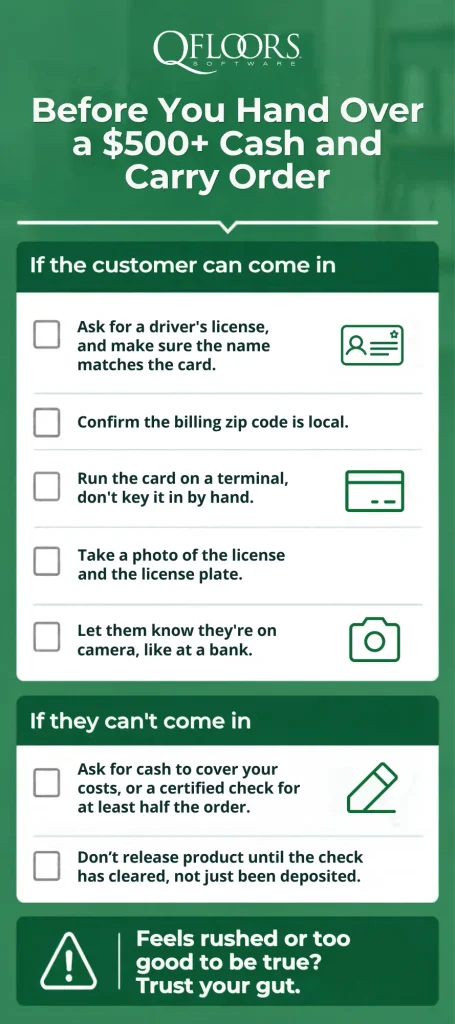
For orders of $500 or more where the customer can come into the store:
- Ask for a driver’s license and confirm the name matches the card
- Check that the billing zip code is local, since stolen cards often trace back to a city far from your store
- Run the card on a terminal instead of keying it in by hand
- Take a photo of the license and the license plate for your records
- Let the customer know they’re on camera, the way a bank would, and ask them to remove hats and sunglasses
One thing to check before you start keeping copies: rules on storing customer ID information vary by state, as do rules on recording. Keep what you need for a dispute and don’t hold onto it longer than that.
If the customer can’t come in:
- Ask for cash to cover your costs, or a certified check for at least half the order
- Don’t release product until a check has actually cleared, not just been deposited
- Ask for the installation address so you can do a site visit
Red flags worth stopping over:
- Pressure and urgency, especially a line like “I have to have this job”
- A second card offered partway through, or a sudden change in zip code
- On online orders, a mismatch between the card number and the zip code
Remember: If something still feels off, hold the order before pickup and call the issuing bank directly to verify the cardholder.
If you’ve already been hit
- Call your processor before you do anything else. Ask what your dispute window is, because it’s shorter than most dealers expect.
- Gather everything you have. Bring up the paperwork, a copy of the ID, security footage, phone records, and any signed pickup authorization you may have. Processors and investigators will ask for all of it.
- File a police report. Some processors require one before they’ll even open a dispute.
- Let others know. Inform fellow dealers in your buying group and flooring community about what you’ve seen. These schemes tend to work one region at a time, and a heads-up can save the next store from being hit.
The bottom line
This won’t eliminate the risk entirely. But a driver’s license check, a terminal swipe, and some healthy suspicion on a rushed cash-and-carry order will stop most scams before they cost you anything.
Pass this along to your sales team. They’re the ones standing at the counter when it happens, and one good question at the right moment is usually all it takes.

See QFloors in Action
Some images in this article were generated with AI.